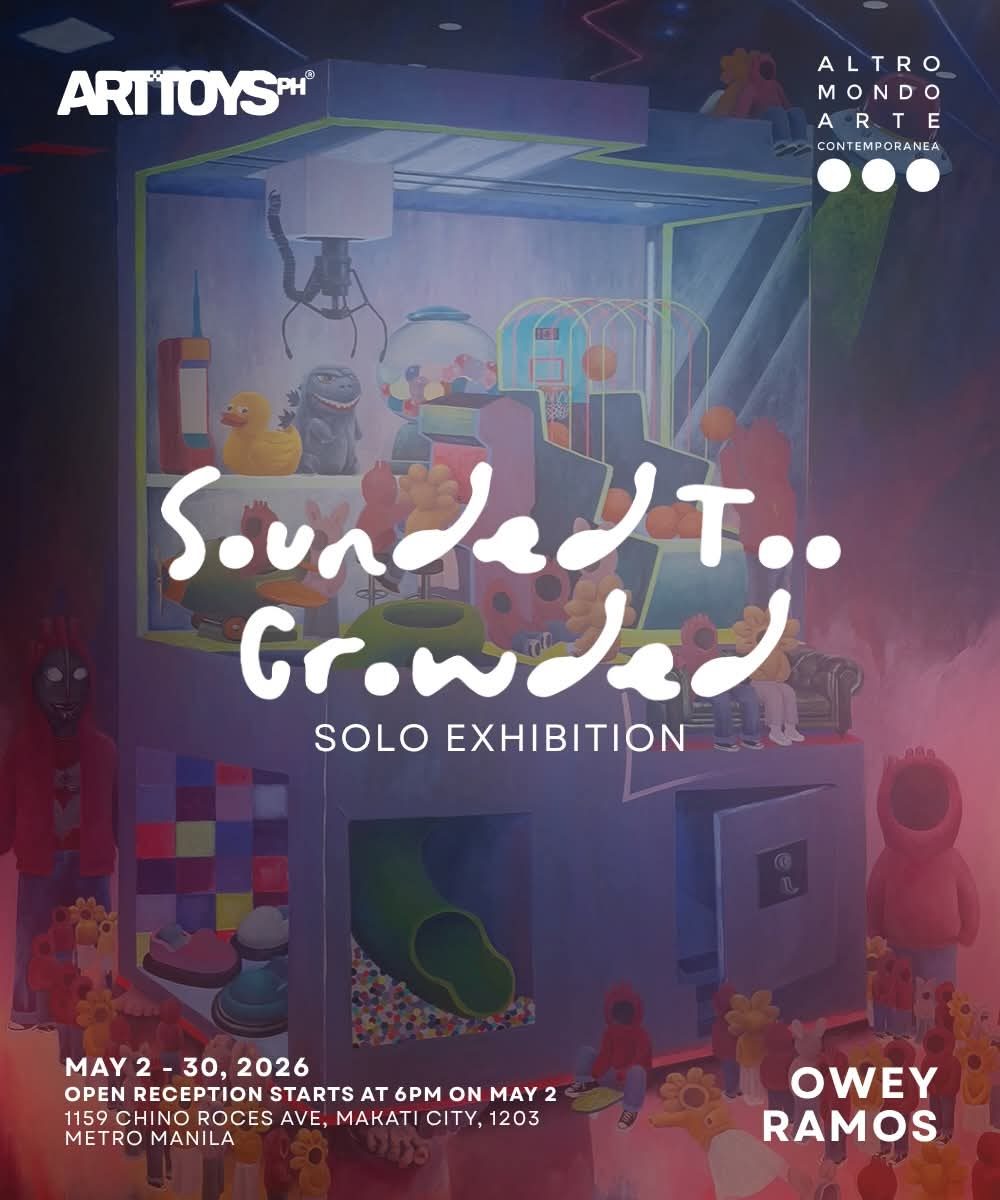
Solo Exhibition · Altro Mondo Arte Contemporanea · 2026
Owey Ramos finds his place in the noise — and makes you feel it.
There is a particular kind of courage in arriving late to a room that is already full — and deciding, this is still where I belong.
Owey Ramos's solo exhibition, Sounded Too Crowded, does not pretend the contemporary art scene is anything other than what it is: loud, saturated, constantly in motion. What makes this show extraordinary is that it refuses to flinch. Instead, it leans in — and finds beauty in the standing room only.
The show opened on May 2nd at Altro Mondo Arte Contemporanea in Makati, presented in partnership with ArtToysPH. Walking in, you are met with work that is vivid, layered, and unmistakably alive — paintings and objects that carry the warmth of someone who has quietly built something real without asking for permission first.
Ramos is a self-taught artist with over fifteen years in the creative industry. He came to the fine art world not through academia, but through persistence, commercial practice, and the particular discipline that grows when you have to figure things out for yourself. His entrance into this space was not a debut — it was a declaration.
The title of this show is not a lament. It is a description — stated plainly, almost matter-of-factly — of the reality that every emerging voice in a living art scene faces. The room is already full. Voices are already established, already competing, already filling every available frequency. And yet here stands Owey Ramos, not complaining about the noise, but painting it.
What the exhibition argues — gently, humanely, and with considerable visual intelligence — is that a saturated environment is not the enemy of art. It is the condition that demands your most distilled self. You cannot bluff your way through a crowded room. The crowd will find you out. You have to actually mean it.
Ramos means it. The works carry a kind of earned confidence — not arrogance, but the particular steadiness that comes from years of working without a guaranteed audience, building a visual language in private, and trusting that it would eventually speak to someone else.
The show is warm without being sentimental. Playful without being frivolous. And in its best moments — genuinely moving in the way that only honest, personal work can be.
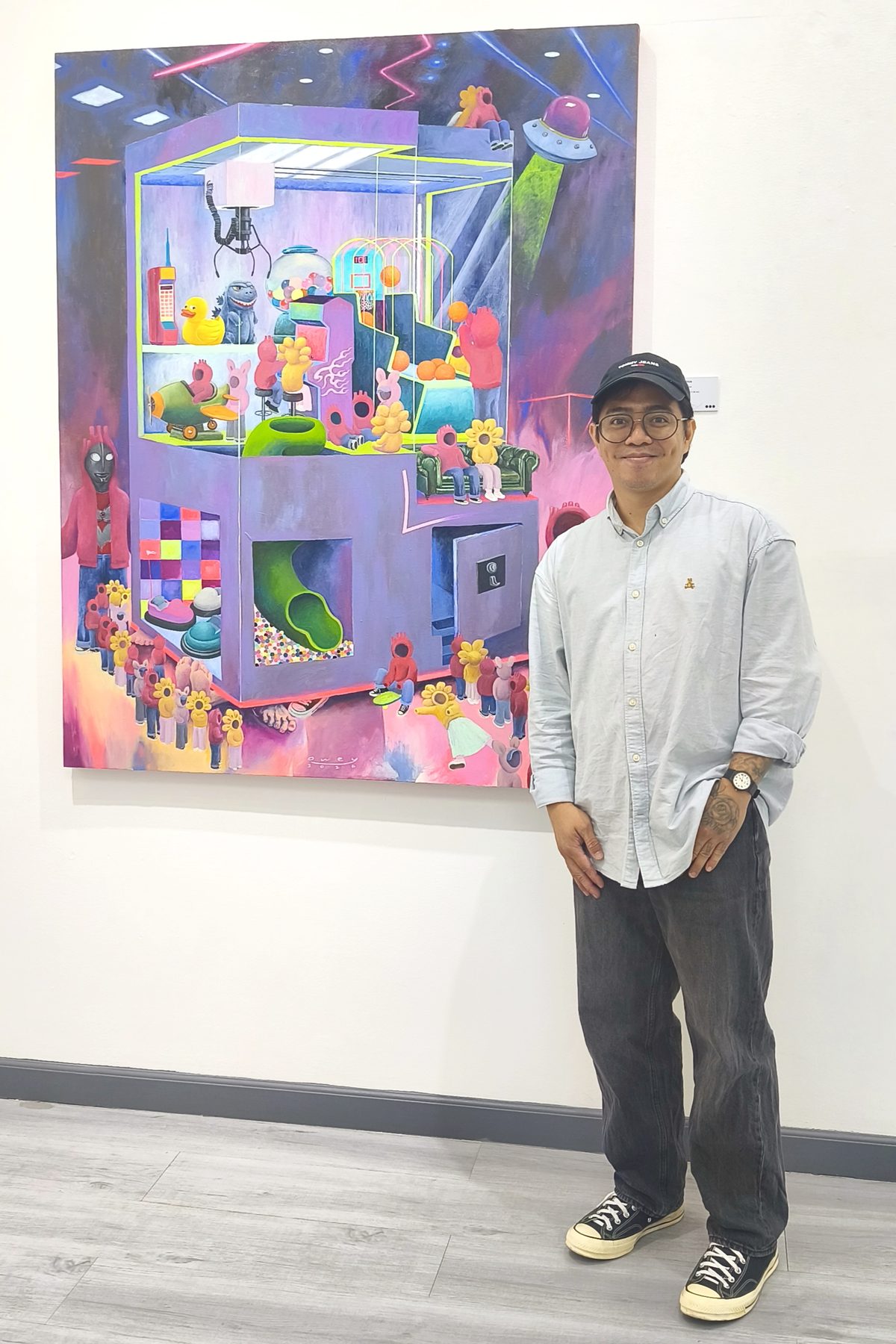
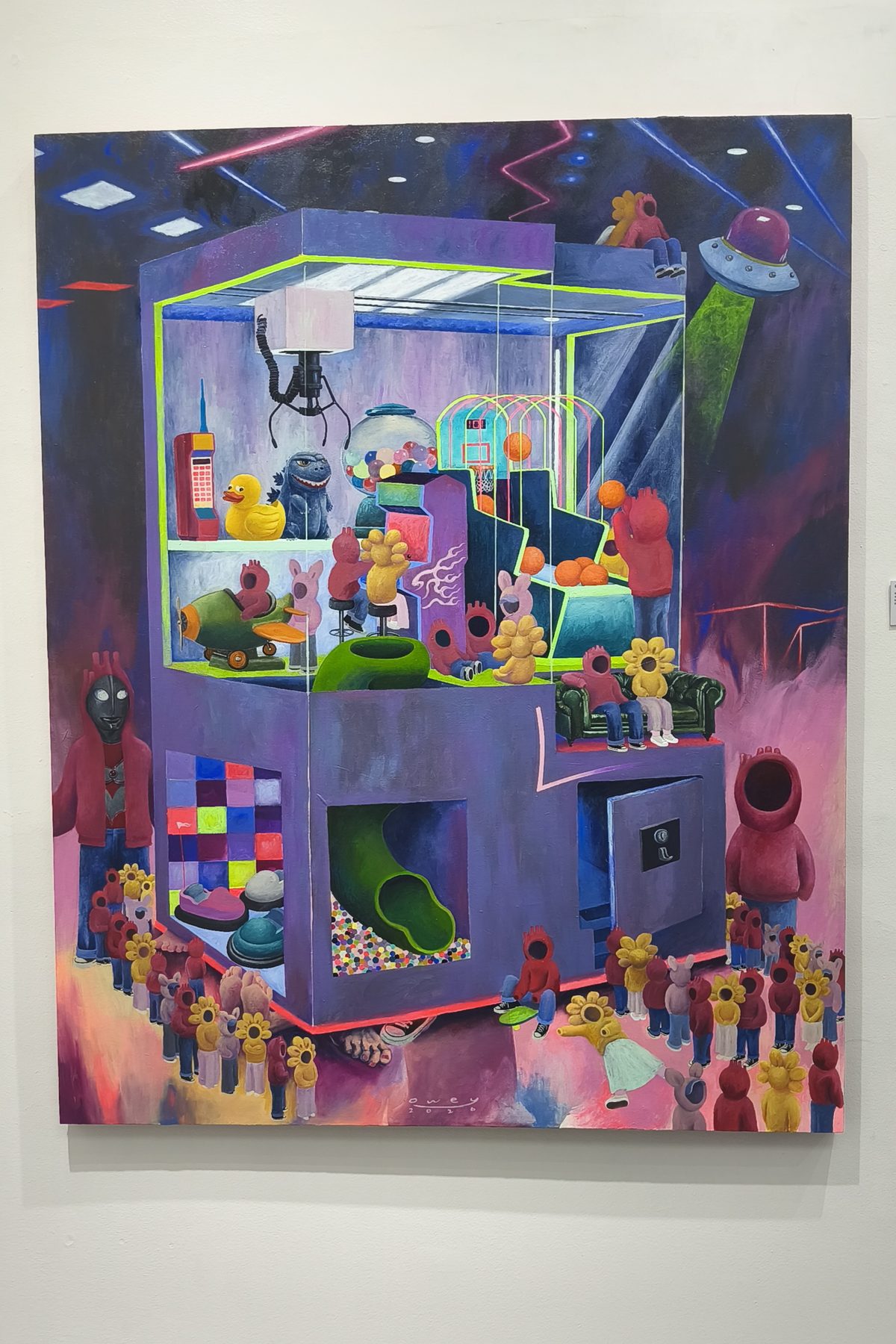
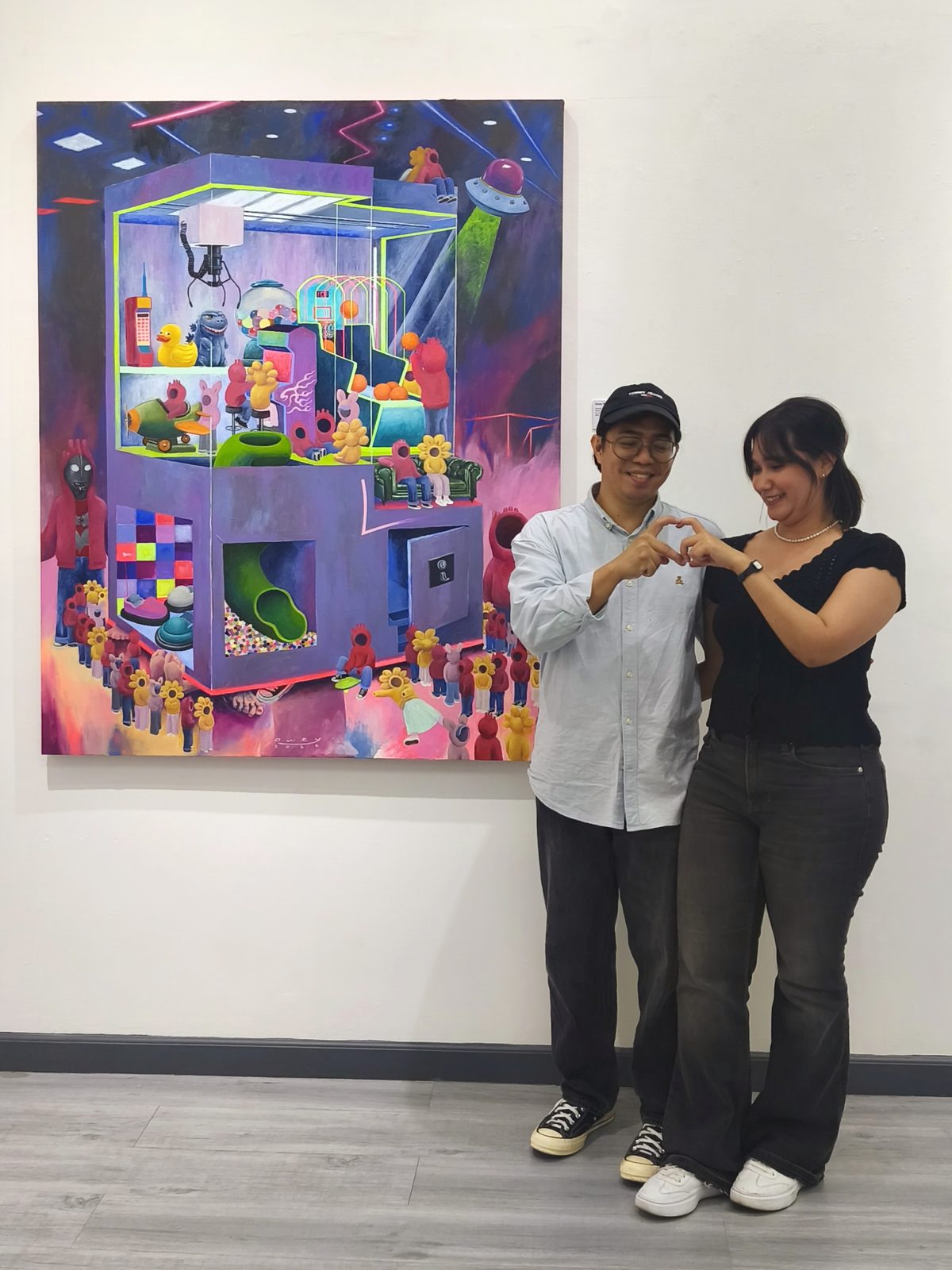
The centerpiece is an acrylic canvas, 54 × 48 inches, rewarding prolonged looking. At first glance it reads as exuberant pop: a claw machine in lavender and acid lime, crammed with toys and figures — a rubber duck, a Godzilla, a basketball hoop. Cheerful and busy and, briefly, nostalgic.
Then you look longer. And you see the figures outside the machine — Ramos's recurring cast from Tbok Town — gathered at the base, looking in, waiting. The machine is sealed. The prizes are visible. The gap between wanting and receiving is exactly the width of glass.
This is what makes the painting extraordinary: it holds tenderness and critique in the same gesture. The art world — any system of access and validation — is the claw machine. The claw moves, sometimes unpredictably. And yet the figures keep showing up. They understand that participation is the only real alternative to disappearing.
Ramos does not paint despair. He paints persistence — and persistence, in his hands, is quietly, stubbornly beautiful. Even the waiting crowd feels vibrant, held together by some shared, unspoken faith that it is worth it to stay.
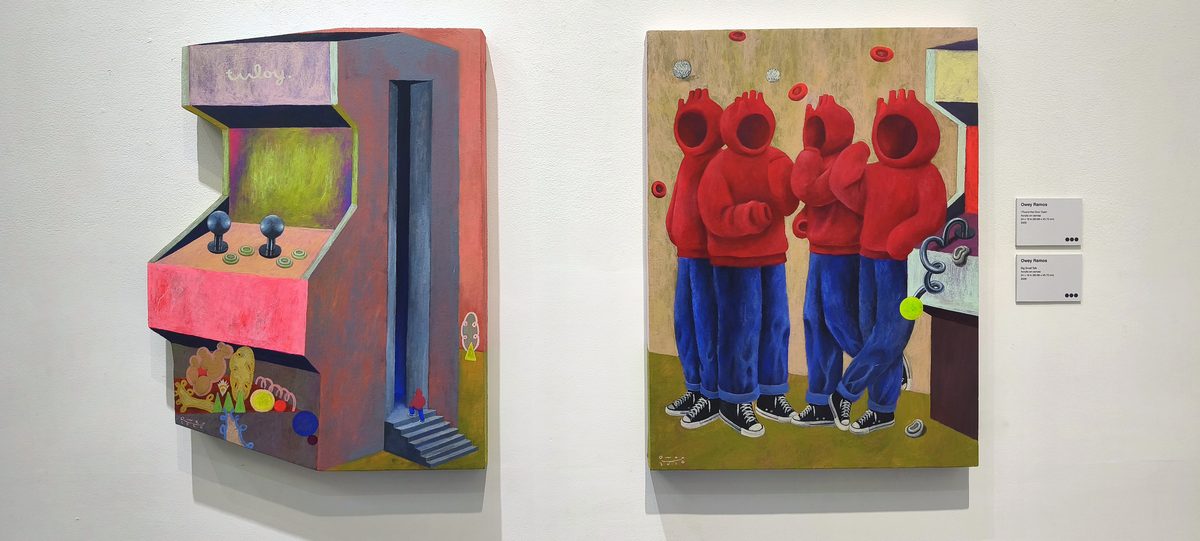
There is something immediately startling about this piece — not its subject matter, but its form. The canvas itself has been shaped: cut and built out to follow the contours of an arcade cabinet, so the painting protrudes from the wall. It insists on existing in three dimensions.
Marked with the word tuloy, a Filipino word meaning "go on," "come in." At the base, the tiny familiar figures of Tbok Town navigate the miniature stairs, finding their way into something that looks closed but was, in fact, left open.
That the door was open is not triumphant news in Ramos's telling. It is something quieter — a discovery made not by forcing entry, but by simply staying long enough to notice.
Four figures, shoulder to shoulder, in red hoodies and blue jeans. Their sneakers — black Converse, laces neat — are the most specific thing about them. Their faces are hollow, open, like megaphones turned inward. Talking. Or listening. Or both.
Big Small Talk is the most tender painting in the show. The conversations that hold everything together are often the ones that don't announce themselves as important. They happen in the hallway. Before or after the thing that was supposed to matter.
The figures are indistinguishable in the way that belonging sometimes makes you — not erased, but part of something. The red is warm. You feel like you have been in a conversation like this before.
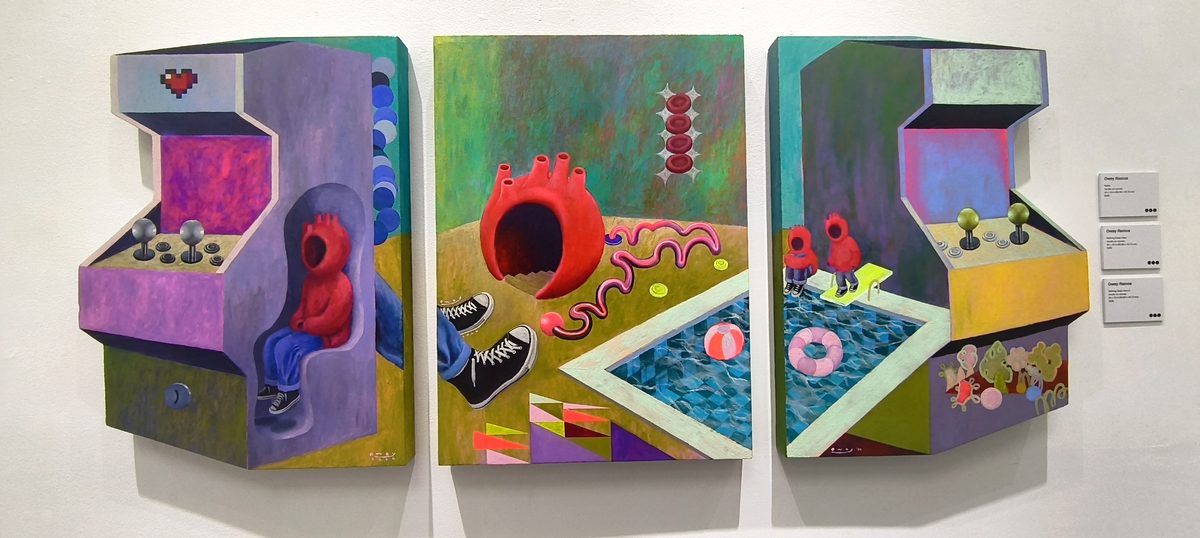
The arcade cabinet form returns, housing a single Tbok Town figure seated deep inside it, small against the machine's pink interior. A pixelated heart glows above. There is something deeply private about the image: a creature folded into its own space, comfortable with solitude.
Niche does not feel like isolation. It feels like sanctuary. The figure has found its corner — its groove, its frequency — and settled there without apology. The machine is not a trap here. It is home.
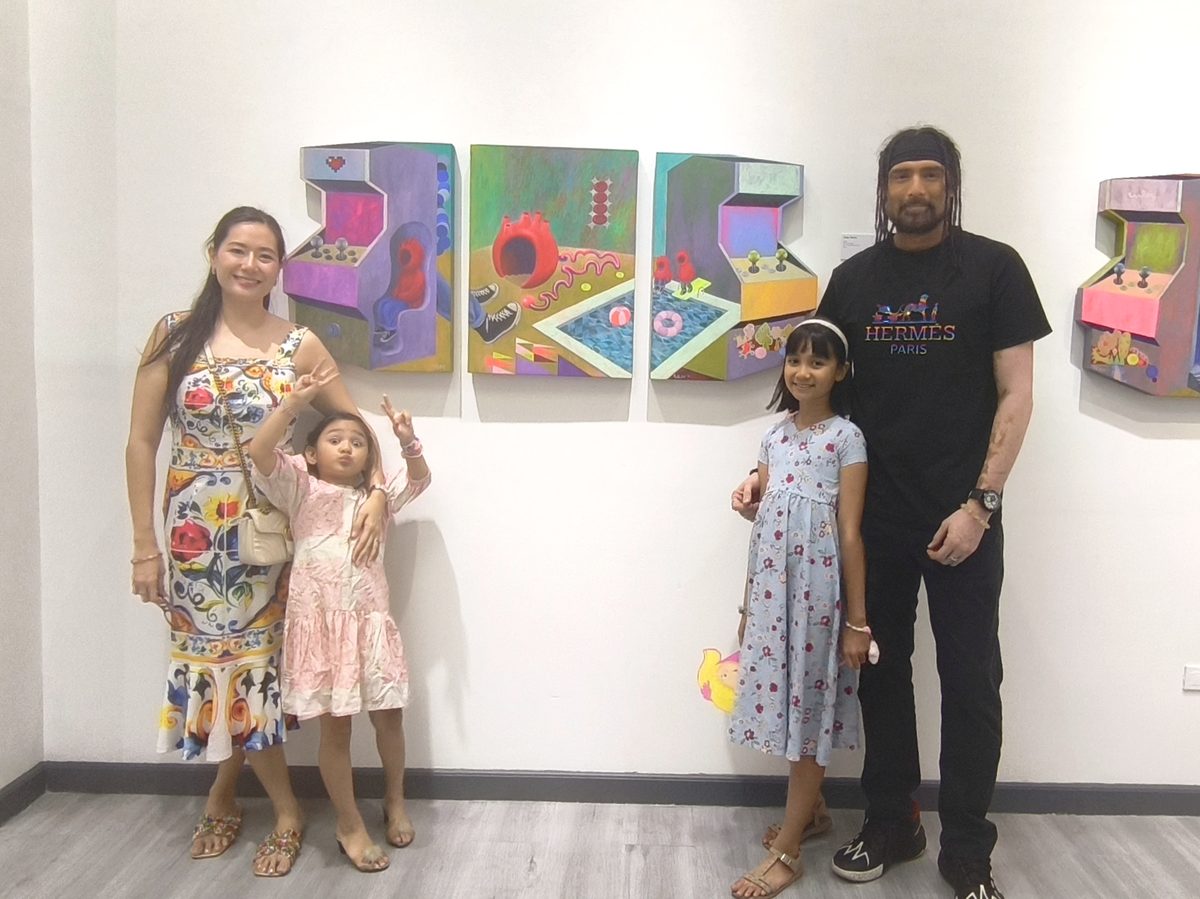
There is a pool. A beach ball. A neon pink serpentine shape coiled across warm olive ground. Converse sneakers step in from the bottom edge. A hollow red heart-shaped object sits open-mouthed at the centre, like something that once held something and now does not.
The title announces nothing deep here. It is, of course, a provocation. The pool is shallow. The ache is not.
Another arcade machine, this time in teal and gold. A figure in a red hoodie stands at the edge of a painted pool, a yellow diving board at their feet. Together the pair complete a quiet argument: that play is not a lesser register of experience. The pool, the dive, the float — these are the serious work.
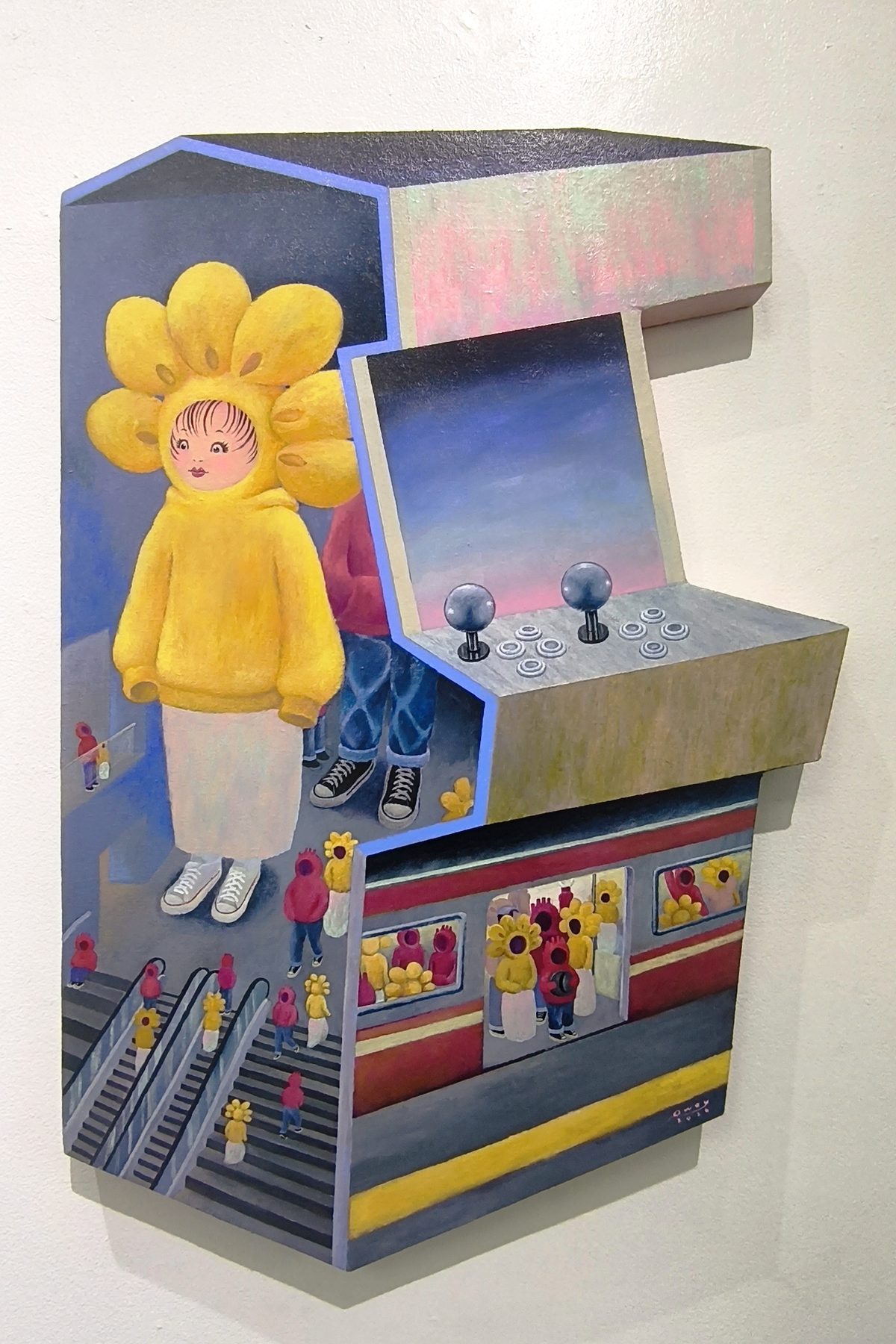
She is the most visually commanding figure in the entire show. Dressed in a sunflower hoodie — yellow petals fanning around a round, painted face — she stands front and centre on another shaped arcade canvas, grinning directly outward. She is completely unbothered by whatever she sees.
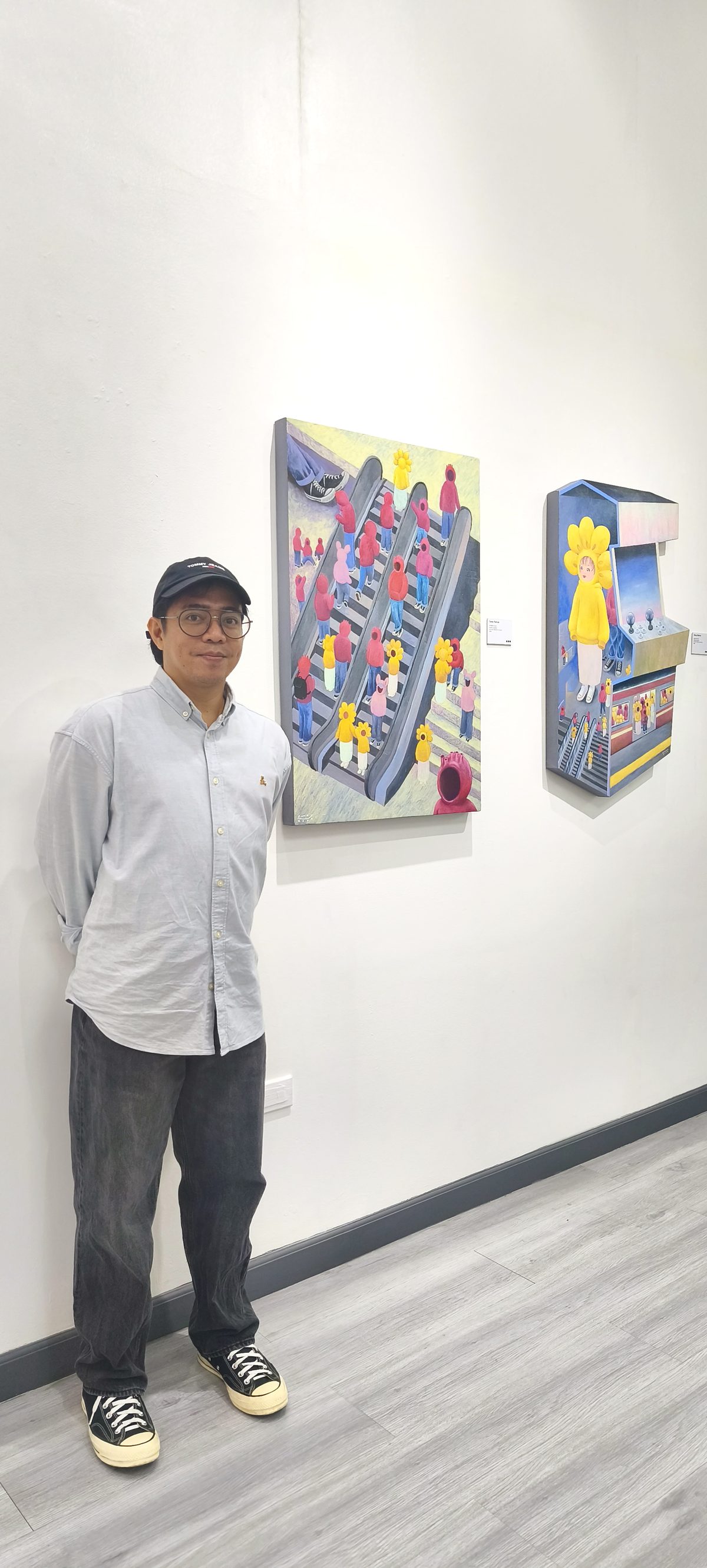
Below, an escalator descends into a train platform packed with the same sunflower and red-hooded cast, a whole community of them boarding, arriving, going somewhere together. The machine's screen shows a bruised lavender sky — the kind you see from a train window when the city is just beginning to wake up.
The title is not ironic. Larger Than Life is a straightforward declaration: some presences simply exceed the container they're placed in. Her petals nearly touch the edges. She is too much for the frame, and she knows it, and she smiles anyway.
This is Ramos at his most generous. He is not painting aspiration. He is painting someone who has already arrived — at themselves.
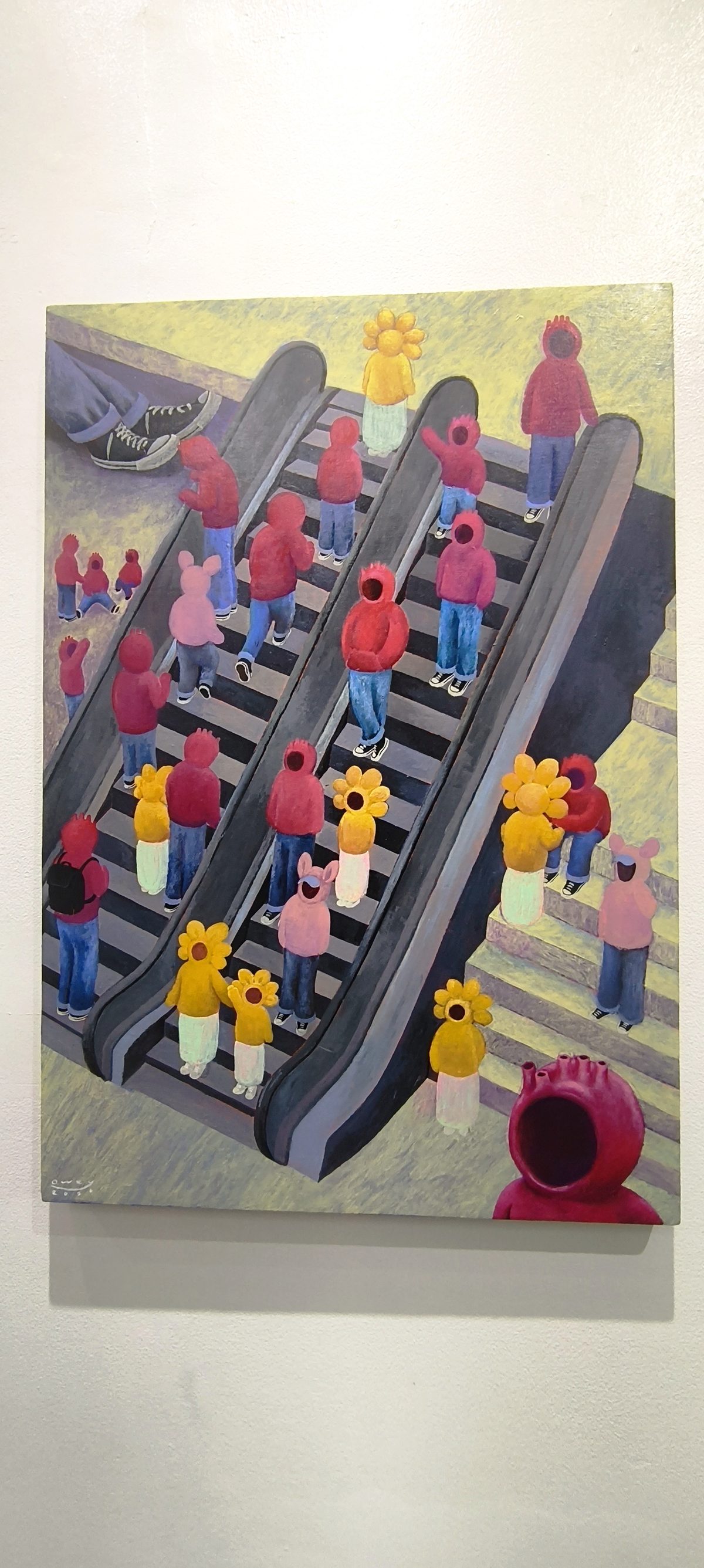
The escalator from Larger Than Life appears again here, now as the whole composition — two moving staircases viewed from directly above. The Tbok Town figures ride upward in a slow communal procession: red hoodies, yellow sunflower heads, a lone pink rabbit. Nobody pushes. Nobody rushes. They simply go.
It is the most democratic image in the show. No hierarchy of placement, no obvious protagonist. The sunflower figure — who commands the entire canvas in Larger Than Life — is here just one more body on the escalator, partway up, unremarkable in the movement of the whole.
At the top left, a pair of Converse sneakers — the artist's recurring signature, half-glimpsed — suggest that Ramos himself is standing just outside the frame, watching with care, painting every single figure as if they matter.
Because they do. Everyone is in motion. Everyone is on their way. The escalator carries all of them with absolute, mechanical impartiality. Ramos finds something deeply moving in that. So do we.
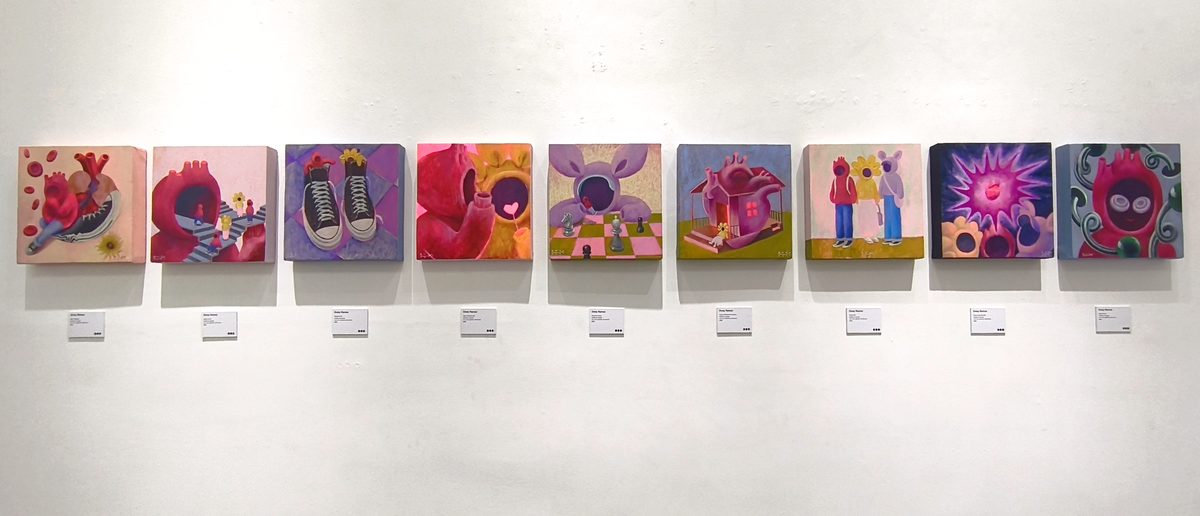
The far wall is given to nine small canvases — twelve inches square each — hung in a single horizontal row. Individually they are intimate, almost diaristic. Together, read left to right, they form something closer to a sentence: a sequence of moods, questions, and discoveries that trace the interior life of someone thinking carefully about what it means to be here, making things.
These are not footnotes to the larger works. They are the conversation happening underneath them — the notes in the margin of a practice that has learned to be fluent without losing its uncertainty.
The leftmost panel opens with a gut-punch that is also, somehow, gentle. A figure is curled at the base of something vast and organic — a dark, jaw-like form that might be a machine, a creature, or the inside of a thought. The figure is small. Whatever it is thinking about is enormous. Been Thinking is the most inward image in the show — a painting about what happens when you sit alone with something you haven't resolved yet, and it grows large enough to hold you inside it.
A house built from a heart. The architecture of the home follows the shape of a cardiac organ — chambers as rooms, valves as doorways. A small sunflower figure stands at the entrance. This is among the most tender images Ramos has made: the idea that the place you return to is not a structure of walls and floors, but a living, feeling thing.
A pair of black Converse sneakers — laces loose, as though just stepped out of — dominates the canvas from above. A tiny yellow flower figure peers from the top. The sneaker carries the artist's presence wherever it appears across this show. Shoes To Fill asks: whose shoes are these? And does the act of stepping in change the shape of the thing itself?
Pink and amber dissolve into one another, and at the centre a small pink heart floats, suspended, in a tunnel of warmth. Take A Closer Look is an invitation and a confession at once — the heart, visible, offered plainly: if you stop long enough, it will not disappear. It has been here the whole time.
A chessboard in lavender and mauve, with an oversized hollow-headed figure crouched at its centre. Black chess pieces scattered across the squares. Pawn For A Day is Ramos at his most precise: a painting about navigating systems that were not designed with you in mind, where surviving a single move, a single day, is enough.
Three figures — a sunflower head in yellow, a hollow-faced red in a hoodie, a soft grey presence — stand together on warm green ground. Three is enough, this image says. Community is a thing that can exist in a triangle — in a conversation between three people who understand each other well enough to stand without talking.
The most radiantly strange image in the series: a sun-burst of violet and magenta, emanating from a central glowing heart. It reads like a vision or a diagnosis — something seen from inside a feeling that has no name yet. Ramos paints it fully, fills it with light, and leaves the question open — because some things are best approached with curiosity rather than definition.
A hollow-headed figure stands at the mouth of a deep tunnel. What's Next? is the question that haunts every creative practice: after the show, after the work is finished and out in the world — what do you do with the silence that follows? Ramos paints the threshold, honest and unresolved, and trusts that staying in the question is also a form of courage.
The rightmost panel closes the wall in deep indigo and baroque swirl — the most formally ornate work in the exhibition. A face stares outward, wide pale eyes set inside a helmet of dark curling pattern. Both mask and face. Both surface and interior. Twist Of Fate reminds us that every artist contains more than one tradition — and the most interesting work happens at the place where they collide.
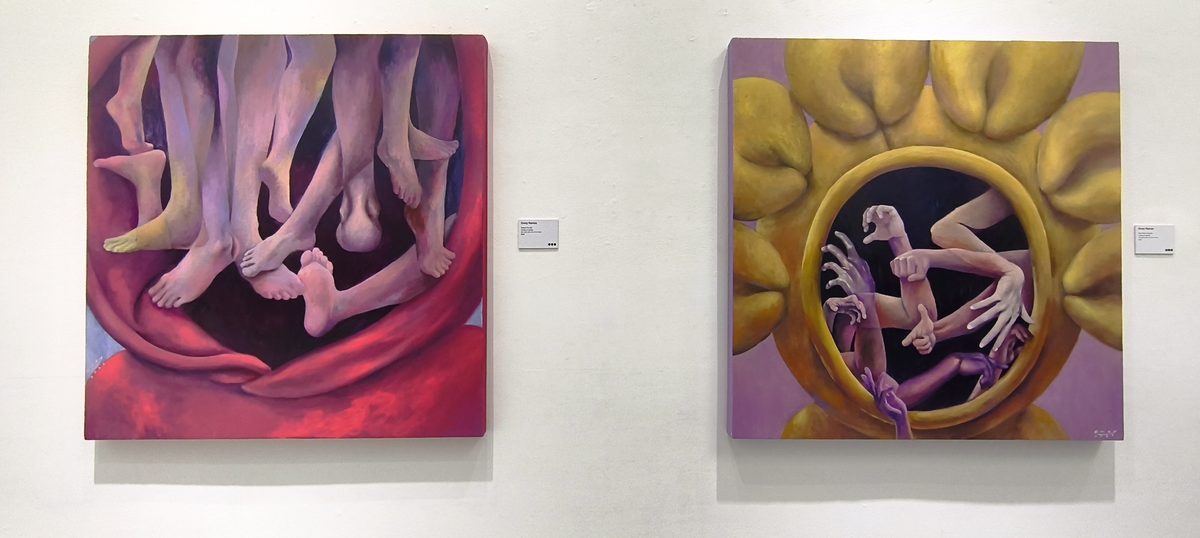
Two paintings that abandon the toy vocabulary entirely — and reveal what has been underneath it all along.
There are no Tbok Town characters here. No arcade machines. What Ramos gives us instead is a canvas filled entirely with bare human feet — dozens of them, pressed together, stacked and layered, descending into a deep fold of crimson fabric. We see no faces. No context. Only this — the part of the body that carries the weight, that meets the ground, that moves forward or stays still.
Feet are among the most honest parts of a person. They show where you have been. They show whether you kept walking. The title means: you did what you said you would do. You followed through. Here Ramos renders that with extraordinary literalness and tenderness: a crowd of people who have all, in their own way, kept moving.
In an exhibition about navigating a crowded space, this is the painting that says: the crowd has feet. It has kept going. That is not a small thing. That is everything.
A circular aperture — framed in gold, ringed by the swollen petals of a giant sunflower — opens into darkness. Inside: hands. Arms. Limbs reaching, grasping, contorted. The figure within is compressed into the opening, part emerging, part still caught.
The sunflower here is not the gentle yellow-hooded character from across the room. It is enormous, architectural, almost indifferent — a structure through which something is trying to pass. Beautiful and unyielding.
This is the most physically intimate image in the exhibition — the most honest account of what creative ambition actually feels like in the body. Not a clean leap through an open door. The reaching, the compression, the hands finding holds in the dark, the slow unglamorous work of pulling yourself through an opening that was not made for you. More than a handful — more than any single reading can contain.
Owey Ramos has made a show about the crowd — and at its heart, it is the most personal body of work imaginable. Every figure is a self-portrait.
There is a version of this story that gets told about artists all the time: the sudden discovery, the overnight arrival, the moment when everything clicks. Sounded Too Crowded tells a different and far more beautiful story. It is the story of someone who found their voice not in a single flash of revelation, but slowly — through discipline, through repetition, through the quiet insistence on showing up to the work every day until the work started showing up for them.
Owey Ramos found his niche. He found his flow. And in finding those things, he found something that cannot be taken away: a visual language so distinctly his own that it could belong to no one else. That is the real achievement here — not a debut, not a statement, but a flowering. The proof that when you stay true to what moves you, when you trust the instinct and do the work and refuse to let the noise of a crowded world drown out your own frequency, something extraordinary becomes possible.
You walk into this exhibition and you feel it immediately — the warmth, the joy, the tender intelligence of a person who has truly arrived at themselves. Owey Ramos is not waiting to be discovered. He has already discovered what matters most: that the work, done with love and honesty, will always find its crowd.

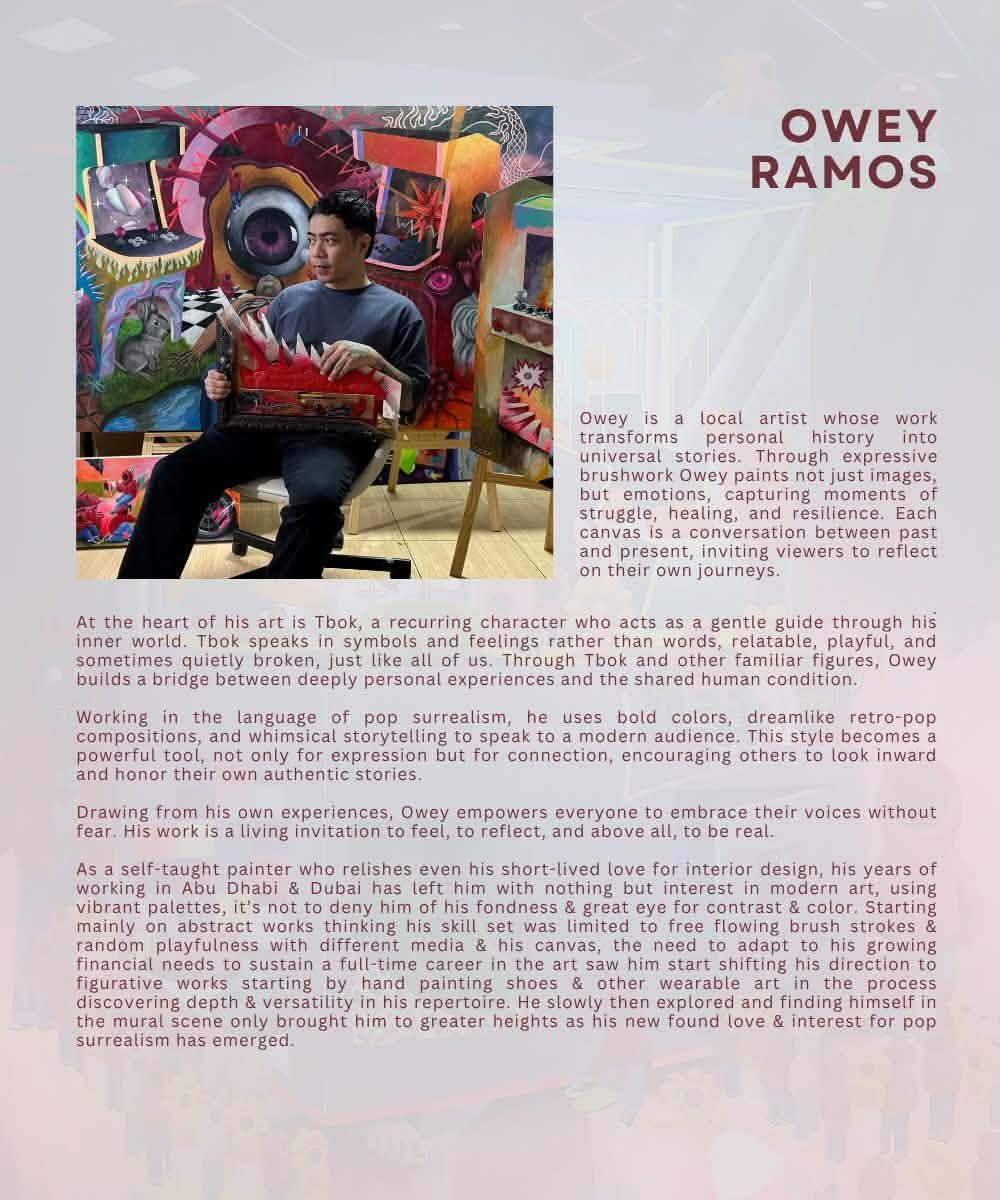
At the heart of Owey's work is Tbok — a recurring character who acts as a gentle guide through his inner world. Tbok speaks in symbols and feelings rather than words: relatable, playful, and sometimes quietly broken, just like all of us. Through Tbok and other familiar figures, Owey builds a bridge between deeply personal experience and the shared human condition.
Working in the language of pop surrealism, he uses bold colors, dreamlike retro-pop compositions, and whimsical storytelling to speak to a modern audience — not only as expression, but as connection. His work is a living invitation to feel, to reflect, and above all, to be real.
A self-taught painter, Owey's path moved through interior design, years working in Abu Dhabi and Dubai, hand-painted shoes and wearable art, murals, and abstract work before arriving at figurative pop surrealism — a practice shaped less by formal training than by curiosity, adaptation, and an unwillingness to stop exploring. None of it was wasted.
An exhibition is never just the work on the walls. It is also the evening it opens — the people who showed up, the conversations that happened, the feeling in the room when the room is full of exactly the right kind of crowd.
We came on opening night — my wife Krisheela, our daughters Kashmir and Ostara, and I. What I did not expect was how quickly the children understood the work. Kashmir stood in front of All Walks Of Life for a long time. Ostara pointed at the sunflower girl in Larger Than Life and said she looked happy. She was right.
That is the thing about Owey Ramos's work that no critical apparatus can fully account for: it is genuinely, immediately felt. By children. By collectors. By people who have never been to a gallery before and wandered in off Chino Roces on a warm May evening and found themselves staying.
That is not a small achievement. It is, in fact, the whole achievement.
"Rather than separating from the crowd, the work acknowledges the position within it. The figures are not removed from the system — they are part of it, learning how to move through it."
The exhibition runs through May 30, 2026, at Altro Mondo Arte Contemporanea, 1159 Chino Roces Ave, Makati City. It is worth the visit.